


Retrieval-Augmented Generation (RAG) & Large Language Model (LLM) Integration: Why It Matters for Enterprises
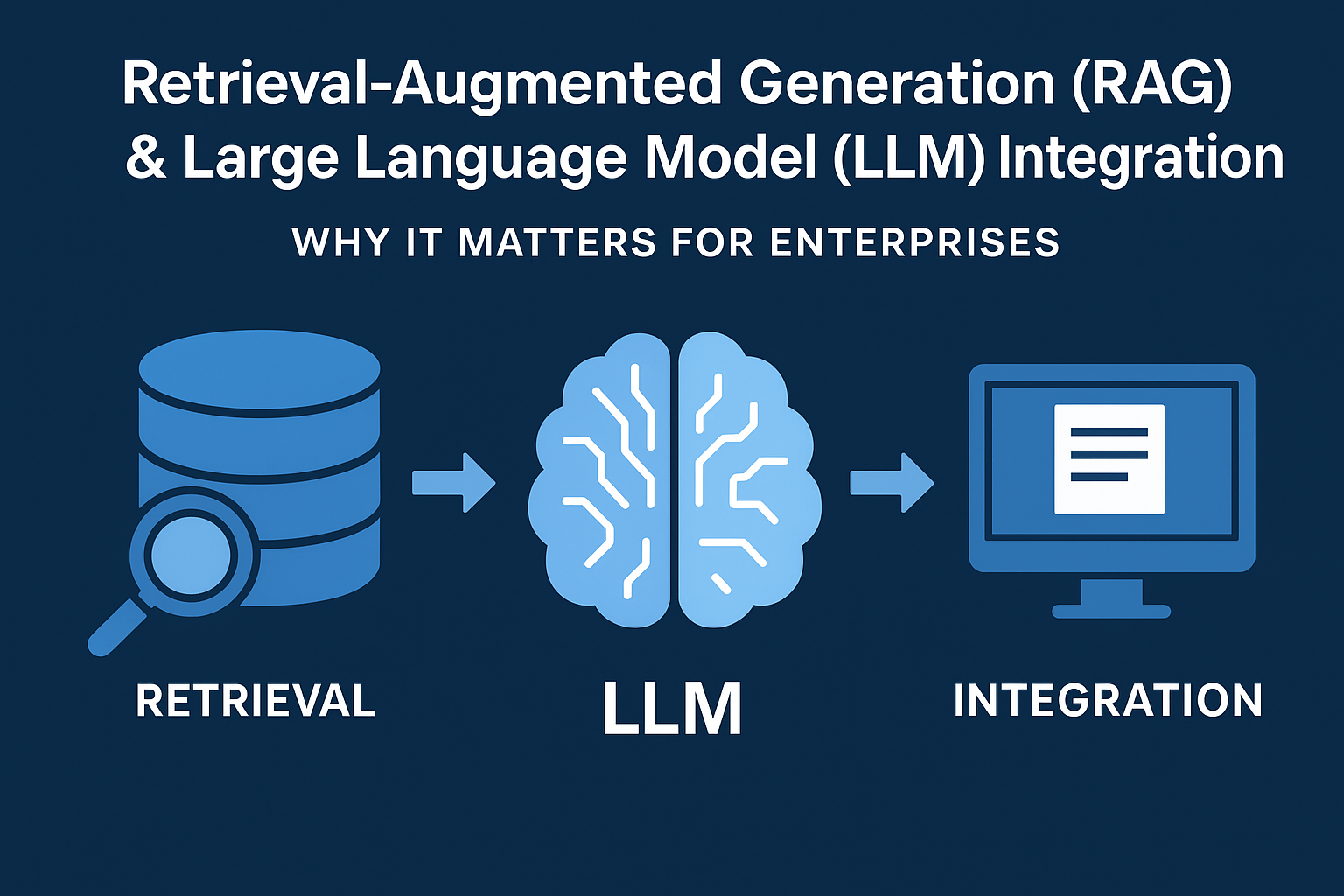
Artificial intelligence is moving at a remarkable pace, and businesses that fail to adopt it risk falling behind. Among the most promising developments is Retrieval-Augmented Generation (RAG), a method that enhances the performance of Large Language Models (LLMs) by connecting them with real-time, domain-specific data. For CTOs, enterprise leaders, and decision-makers, understanding how RAG and LLMs work together isn’t just a technical curiosity — it’s a strategic imperative.
What Is Retrieval-Augmented Generation?
At its core, an LLM like GPT or LLaMA generates responses based on patterns it has learned from training data. While these models are incredibly powerful, they often face two major challenges:
- Knowledge cutoff: Models are only as current as their last training cycle.
- Hallucinations: They sometimes generate plausible but incorrect information.
RAG solves these problems by integrating a retrieval mechanism that pulls relevant documents, knowledge base entries, or structured data in real time. Instead of relying solely on what the model “remembers,” it consults authoritative sources before producing a response. This makes answers more accurate, trustworthy, and domain-specific.
Why Enterprises Should Care
For enterprises, LLM integration with RAG isn’t about hype — it’s about creating practical business value. Imagine a financial services firm needing compliance-ready reporting, or a healthcare company requiring precise clinical information. In both cases, traditional LLMs might struggle with outdated knowledge or vague outputs. With RAG, the system can reference real-time compliance documents or clinical research, ensuring reliable, auditable responses.
Businesses that want to stay ahead are turning to AI and ML solutions that make this possible. Integrating RAG with enterprise-grade LLMs creates systems that are not only intelligent but also accountable.
Key Benefits of RAG + LLM Integration
When deployed strategically, RAG-driven LLMs bring enterprises several advantages:
- Domain-Specific Intelligence
Models can pull from internal databases, compliance libraries, or research repositories, ensuring answers are tailored to your organization’s needs. - Reduced Hallucinations
By grounding responses in verified sources, enterprises get reliable and auditable results. - Enhanced Search & Knowledge Management
Employees no longer need to dig through endless PDFs or dashboards. Natural language queries can surface relevant insights instantly. - Scalability Across Use Cases
From customer support chatbots to audio and video analytics, RAG-enhanced LLMs can adapt to multiple business functions. - Future-Proof Infrastructure
With integration into cloud deployment platforms, these systems scale as data grows.
Practical Applications Across Industries
Enterprises across sectors are already seeing measurable gains:
- Healthcare: RAG ensures medical chatbots pull from peer-reviewed research instead of generic internet sources.
- Banking & Finance: Regulatory compliance reports generated with RAG reduce the risk of costly errors.
- Manufacturing: Maintenance teams use RAG-enabled assistants to query machine manuals and safety protocols in real time.
- Education & HR: Tools like the CamEdge Attendance System demonstrate how AI can streamline administrative operations.
Forward-thinking enterprises are already exploring generative AI solutions that combine creativity with reliability. The RAG framework ensures these innovations are grounded in accurate and secure data.
Building Trust in Enterprise AI
AI adoption isn’t just about efficiency — it’s also about trust. Enterprises need assurance that outputs are accurate, compliant, and secure. This is where solution providers like ElevateTrust.AI stand out.
By offering enterprise-grade IT solutions, ElevateTrust.AI helps organizations integrate LLMs and RAG frameworks into their workflows. Their approach balances innovation with accountability, ensuring that generative models serve business goals without creating unnecessary risks.
The Road Ahead
As enterprises move toward digital-first strategies, RAG + LLM integration will likely become a cornerstone of intelligent automation. Decision-makers should view it not as an experimental technology, but as an enabler of business resilience, knowledge efficiency, and competitive advantage.
The best way to evaluate these technologies is hands-on. Leaders can explore proof-of-concepts, pilot programs, and interactive AI demos to understand how RAG fits into their unique business context.
Conclusion
Retrieval-Augmented Generation isn’t just about improving AI — it’s about empowering enterprises to make decisions with confidence. By integrating RAG with LLMs, businesses gain intelligent systems that are accurate, secure, and adaptable across industries.?
Check out ElevateTrust.AI to explore trusted, secure, and scalable AI for your enterprise.
